
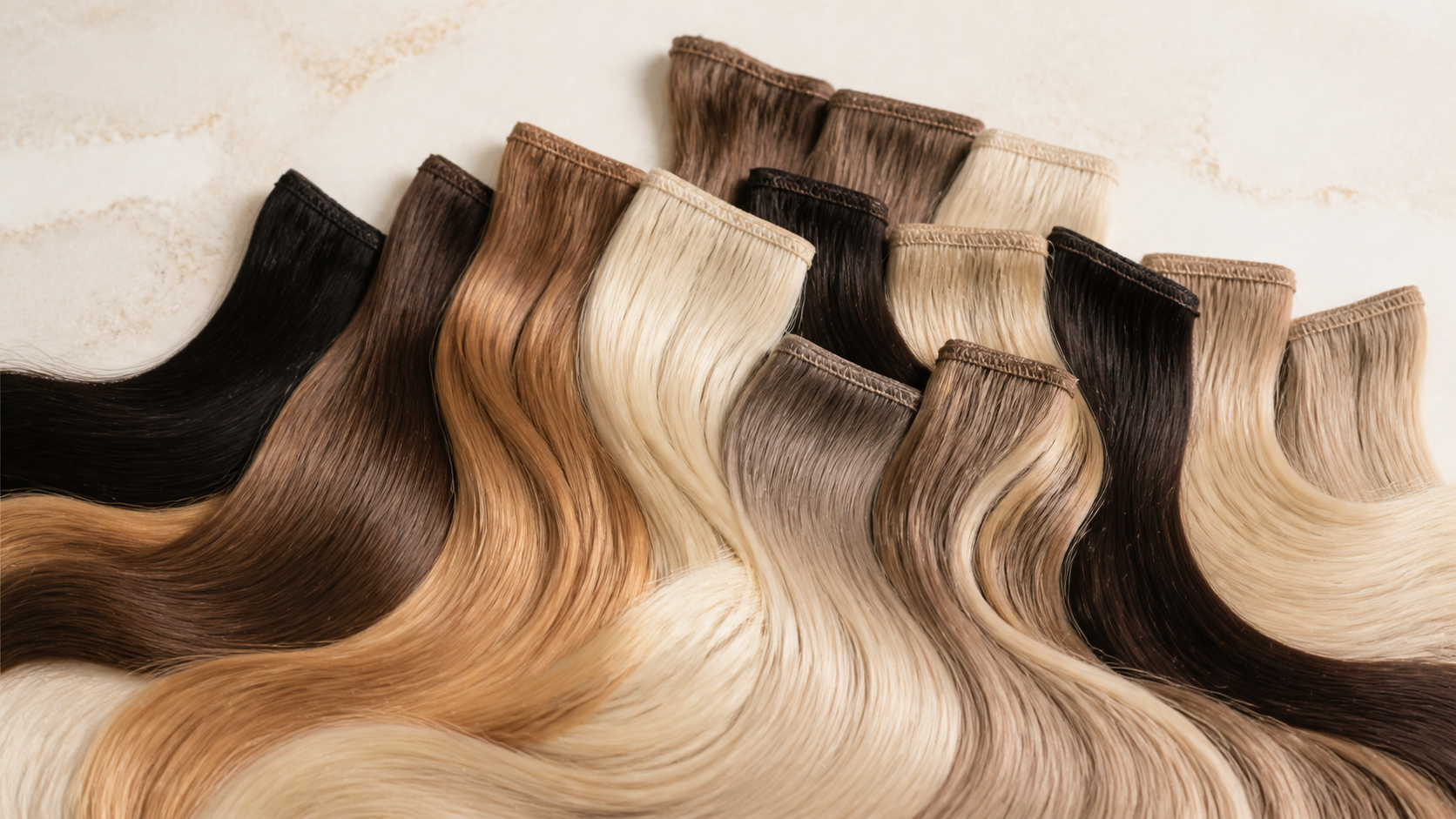
Choosing a hair-extension supplier is not the same as selecting a product from a catalogue. A salon group, distributor or private-label brand is choosing a repeatable supply system: product specifications, colour consistency, communication, quality control and the ability to solve a problem before it reaches the customer.
Start with the commercial brief, not a price request
Before contacting a manufacturer, prepare a one-page brief containing your target market, the methods you plan to stock, the first lengths and colour family, packaging needs, estimated trial quantity and the quality point that matters most. Two quotations for “20-inch blonde weft” can represent very different products.
1. Verify that the supplier understands the construction
For a Genius Weft, ask about seam profile, whether the track can be cut, how the edge is reinforced and what happens at the cut point. For tape-in, ask about adhesive type, tab dimensions and installation preparation. “100% human hair” is a category, not a complete specification: confirm length measurement, net pack weight, texture after washing, colour reference and expected end fullness.
2. Use samples as a comparison set
Request the same method in two or three relevant shades, especially if blonde, balayage or ash colours matter to your launch. During product application, assess whether the weft lies flat, density remains balanced, colour reads consistently under salon and daylight lighting, and the attachment component is clean and consistently formed.
3. Turn sample approval into a written specification
Once a sample is approved, record it. A purchase order should state the method, length, net weight, texture, colour reference, packaging artwork version, labels, carton marking and inspection standard. A reference sample, neutral-lighting photographs and a simple approval sheet reduce repeat-order risk.
4. Evaluate quality control before the order ships
Quality control is a process, not a single photograph. Useful pre-shipment inspection checks quantity, product mix, colour labels, visible construction, pack weight and packaging against the approved order. Ask for specific evidence: packing list, batch labels, selected packs on a scale, sealed-carton photos and an exception report when needed.
5. Compare MOQs in context
Ask separately for the minimum per standard SKU, the minimum for custom colour or texture, and the minimum for branded packaging. Start by validating several core SKUs, then expand the colour ring after you have sales and salon feedback. This protects cash flow while creating evidence for the next purchase order.
6. Check communication and delivery discipline
Confirm the Incoterm, destination, shipment method, carton dimensions, declared product description and who handles import duties. A reliable supplier distinguishes an estimate from a committed production date and confirms changes in writing.
FAQ
What should I ask for before a first bulk order?
Ask for a written specification, sample reference, quotation by SKU, MOQ by customisation type, lead-time range, packaging proof and pre-shipment inspection plan.
How do I check hair-extension quality without a laboratory?
Use controlled side-by-side product application. Check length, pack weight, seam or attachment construction, colour grouping, end density, wash-and-style behaviour and packaging accuracy.
Conclusion
The best supplier is the one that can turn your brief into a clear specification, support evidence-based sampling, inspect the completed order and communicate openly about constraints. That is how a first order becomes a stable B2B supply relationship.